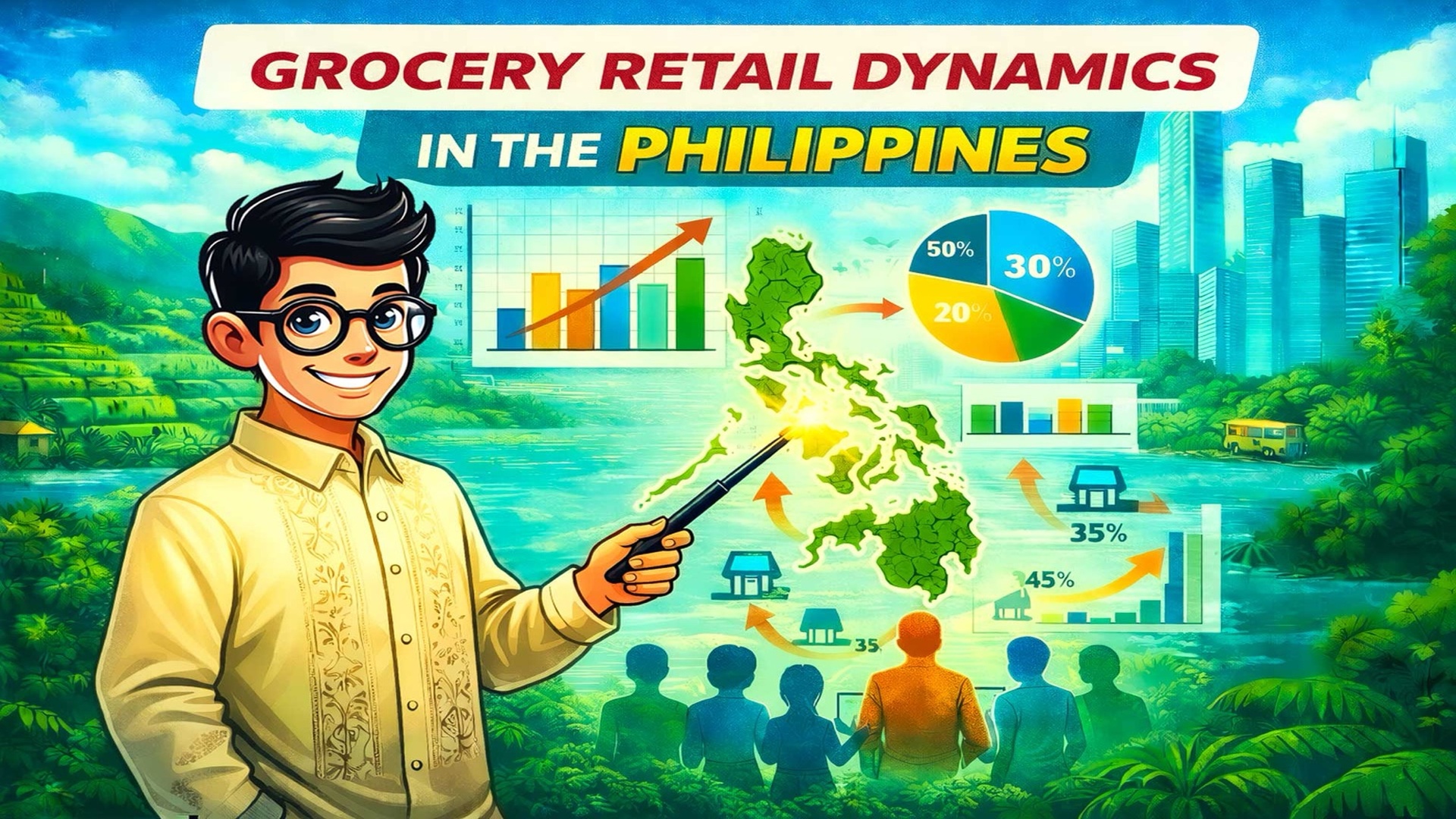
With around 2/3 of grocery spending still going through sari-sari shops, wet markets and other traditional outlets, the Philippines remains one of Southeast Asia’s most traditional-heavy grocery markets
Modern formats capture roughly the remaining 1/3 and are growing fast, especially in urban areas, but the country is still far from the maturity level reached in other Southeast Asian markets such as Thailand and Malaysia, where modern grocery already dominates
Let’s discover it
Philippines in Southeast Asia: key facts
- Population: ~120 million people (#2 in SEA – #14 World)
- Rank in ASEAN by market size: Top 3 (#1 Indonesia & #2 Thailand)
- GDP: US$ ~500 billion
- Household consumption share of GDP: ~75–80% (very consumption-driven economy)
- GDP Growth: ~5–6%,
A traditional – steadily growing – market
The Philippines grocery market one of the largest one and steadily growing, due to consumption still strongly anchored in traditional: small, everyday purchases made mainly in wet markets and neighborhood stores, rather than through large stock-up trips in modern retail formats
Food & Grocery Retail
- 2025: US$ 55.2 billion (#3 is SEA)
- 2028 (est.): ~US$61 billion (~3% per year – Low Tier SEA)
This consumption structure limits the pace of value growth compared with faster-modernising Southeast Asian markets
Why Filipino growth is slower than SEA peers
This is mainly linked to how Filipino people shop for food on a daily basis:
- Frequent, small purchases of everyday essentials
- Strong reliance on traditional retail, such as wet markets and neighborhood stores
- Limited habit of large stock-up trips in modern retail formats
While remittances (overseas family member sending money back home) and demographic fundamentals help keep demand stable and resilient, they mainly support day-to-day consumption, rather than:
- higher-value baskets
- premiumization
- rapid expansion of modern grocery formats
As a result, the Philippines grocery market grows at a steady, low single-digit pace
How large is the traditional grocery market?
Around 64.5% of grocery sales (~US$35.6 bn) in the Philippines still go through:
- Sari Sari Shops
- Wet markets
- Mom & Pop Store
These traditional outlets continue to dominate because they:
- are located close to home
- sell very small pack sizes suited to daily purchasing
- offer informal credit
- are deeply embedded in local communities
Rather than replacing this ecosystem, modern retail has adapted to it. Supermarkets, hypermarkets, and warehouse clubs often supply and support traditional stores, treating them as an essential reseller network
Modern grocery retail is growing — but selectively
Modern grocery formats represent a little over one-third (35.5% – US$19.6 bn) of total grocery spending, and this share is rising, especially in Metro Manila and mid-tier urban centres
Supermarkets: the core modern channel
Supermarkets are the largest modern grocery format – worth around US$11.4 billion
Within this segment:
- Robinsons generated about US$1.5 billion in supermarket sales.
- SM Supermarket reached around US$1.3 billion.
- Savemore Supermarket followed with US$1.2 billion, emphasising fresh produce and meat to give customers easy access to fresh food items.
Smaller, neighbourhood-oriented supermarkets are especially popular. They mirror the convenience of traditional stores while offering:
- A broader assortment, including imported products
- Better fresh-food presentation and cold-chain items
- Promotional mechanics such as loyalty cards and bundle deals
Shopping trips remain frequent and basket sizes small, reflecting limited storage and refrigeration space in many households. Fresh produce, meat, and daily essentials drive most visits.
Hypermarkets: destination stores, not daily shopping
Hypermarkets play a different role in the ecosystem – worth about US$3.8 billion
Key characteristics:
- Often located outside dense urban centres or on major roads
- Function as one-stop destination stores for food and non-food
- Serve both households and small retailers buying for resale
Top players include:
- Puregold with around US$2.2 billion in hypermarket retail sales
- SM Hypermarket with about US$747 million
- Super8 Grocery Warehouse with roughly US$277 million
Puregold is particularly important for low- to middle-income consumers and sari-sari owners, offering products in very small sachets and packs that can be easily resold.
Hypermarkets remain significant for bulk purchases and stocking up, yet their relative importance gradually decreases as consumers prioritise proximity and time savings over large weekly trips.
Others: club stores and regional supermarket chains
This group includes membership-based club stores and regional supermarket operators, which together represent ~5% / ~US$2.5 bn of modern grocery retail
Club stores operate on a membership model, focused on bulk purchases, imported products, and planned stock-up trips rather than daily shopping.
The segment is led by:
- S&R Membership Shopping, the largest and most established player
- Landers Superstore, a fast-growing, slightly more upmarket warehouse club
Alongside club stores, regional supermarket chains also play a role in modern retail expansion.
Metro Retail Stores Group is a key example:
- Strong presence in Cebu, Visayas, and parts of Luzon
- Operates supermarkets, hypermarkets, and value-oriented formats
- Total group sales of around US$720 million, making it a mid-sized but meaningful modern retail player
Together, these formats complement larger supermarket chains, serving specific missions—bulk buying, regional coverage, or value-driven shopping—while remaining secondary channels within the overall grocery market.
Convenience stores: visible, modern — and structurally limited
Convenience stores are a highly visible part of the urban landscape and along transport corridors – worth around US$2 billion.
They are typically:
- open 24/7
- located within walking distance of workplaces, schools, and residential areas
- equipped with dine-in or stand-up eating areas, positioning them as an alternative to fast food
The channel is led by:
- 7‑Eleven, by far the dominant player with around 60% market share
- Ministop (now rebranded as Uncle John’s)
- FamilyMart, with a smaller footprint
Convenience stores focus on:
- snacks, drinks, and ready-to-eat meals
- a growing range of affordable hot dishes
- limited basic grocery items in selected locations
Despite their visibility, convenience stores still represent only a small share of total grocery spending. Their role is to serve immediate consumption and on-the-go occasions, not to replace supermarkets or traditional retail.
Online grocery: growing, but still complementary
E-commerce grocery is expanding from a small base. Filipino consumers spent about US$632 million on F&B products online (~1% of Modern Trade sales)
Top online categories include:
- Dairy products (~US$213.6 million)
- Staple foods (~US$161 million)
- Cooking ingredients (~US$122.9 million)
Popular online grocery platforms include MetroMart, WalterMart Delivery, PureGo, and GoCart, alongside retailer-owned apps and marketplaces.
In practice, online remains a secondary channel in a market where:
- Price sensitivity is high
- Delivery fees matter
- Many shoppers still prefer to choose fresh food in person
Online grocery supports existing habits rather than disrupting them, reinforcing the hybrid nature of the market
Even though modern grocery retail is well established across multiple formats — supermarkets, hypermarkets, convenience stores, club stores, and a growing online channel — its long-term expansion remains constrained
Unless consumer behavior shifts away from daily purchasing, small baskets, and strong reliance on traditional retail, the upside of modern grocery formats will remain limited
Who the Filipino grocery shopper is
The Philippines has a young, growing population and relatively large households.
- Population: around 117–121 million people in the mid-2020s, with projections of about 145 million by 2040
- More than half of the 28.5 million households are couples with children
- Over 20% of households include six people or more, reflecting widespread multi-generational living
Income profile
- Around 28.5% of households are classified as middle class, a share expected to expand
- Average disposable income per household: about US$11,364
- Median disposable income: about US$8,627, among the lowest in Southeast Asia
- Filipinos aged 30–34 show the highest spending power, with average gross income of about US$5,659 per year
This income structure explains:
- Strong price sensitivity
- High demand for small pack sizes and sachets
- Preference for frequent, small shopping trips rather than large stock-ups
Food-outside-the-home habits
Spending habits show a strong food-outside-home component:
- About 28% of Filipinos dine out or buy food outside several times a week
- Typical everyday spending:
- Breakfast: 80–130 PHP (~US$1.4–2.3)
- Lunch: 100–150 PHP (~US$1.8–2.7)
- Dinner: 150–200 PHP (~US$2.7–3.6)
This behaviour reinforces the importance of:
- Convenience stores and quick-service restaurants
- Grocers that integrate ready-to-eat and foodservice elements
The Philippines also shows a relatively high share of male grocery shoppers, which is relevant for product design and in-store marketing.
Could this be the future of grocery retail in the Philippines?
Indonesia, where traditional markets still account for ~70% of grocery sales, offers a comparable structure to the Philippines.
Despite this similarity, grocery retail growth in Indonesia is around twice as fast. The key difference is the role of mini-markets
Led by Alfamart and Indomaret, they represent ~75% of modern grocery retail.
Their success comes from the match to local shopping habits:
- frequent visits
- small baskets
- neighborhood proximity,
and act as a direct alternative to traditional markets
Developing a similar mini-market format could accelerate modern grocery adoption in the Archipelago…
We hope this article helps you get a clearer picture of the Filipino grocery retail market.
Feel free to share your feedback in the comments, or let us know which other country you would like us to cover next.
Thank you
The WizArno Team
Discover More:


Sponsors link section – it will help to do new videos 🙏
Here you can read more on the Philippines:
Easy Tagalog Phrase Book: Over 1500 Common Phrases For Everyday Use – Kindle Edition
A History of The Philippines – Kindle Edition
Lonely Planet Philippines (Travel Guide) – Kindle Edition
If you like this post, please buy me a coffee
https://buymeacoffee.com/wizarno
🎥 Made with GoPro, iPhone, MacBook (affiliate links — supports the channel 🙏)
👉 Get them on Amazon: https://amzn.to/45Pmg84
$ Cheaper on Amazon Renewed: https://amzn.to/4mRpPRc
Watch this content securely with NordVPN
https://go.nordvpn.net/aff_c?offer_id=15&aff_id=108353&url_id=902






Leave a Reply